Unlocked Issue 9 | August 2026
Welcome to Unlocked
The Gates Foundation Open Access Newsletter
August 2026 | In this Issue
- Looking Beyond APCs: Explore Your Publishing Options
- Learn How to Preprint Your Gates-Funded Research with VeriXiv (Upcoming Webinar)
- VeriXiv Introduces Trust Marker Badges for Preprint Verification
- Explore the Updated Open Access Website
- Spotlight: GRIOS, the Global Research Initiative on Open Science
- Thoughts & Talks
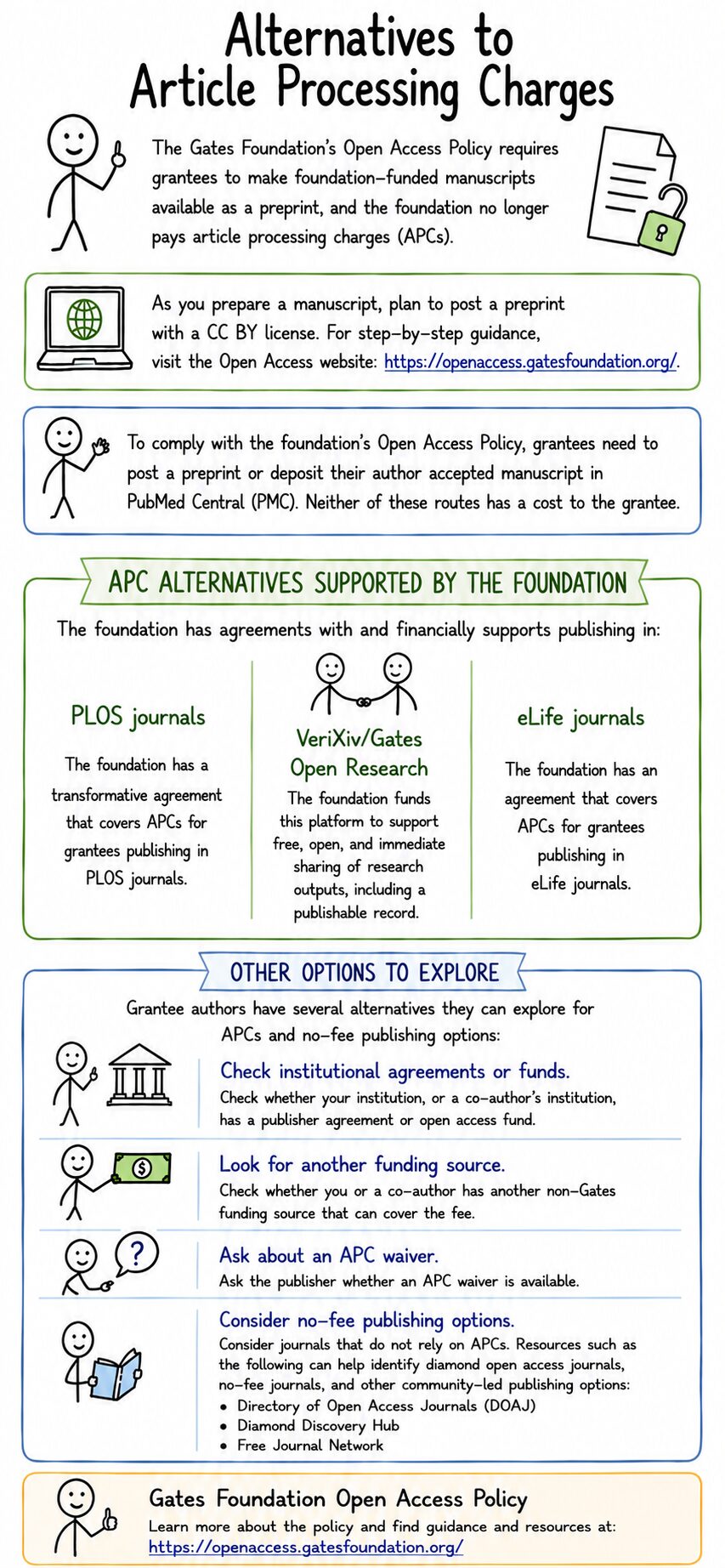
The Gates Foundation’s Open Access Policy requires grantees to share foundation-funded manuscripts as preprints under a CC BY license. It is no longer a requirement to make the journal version of record open access or publish in a fully open access journal. Although the foundation no longer pays article processing charges (APCs), several no cost and alternative publishing routes are available.
Grantees can comply with the policy by posting a preprint or depositing their author- accepted manuscript in PubMed Central (PMC). Neither route has a cost to the grantee.
The foundation also has agreements with or financially supports publishing through:
• PLOS journals
• VeriXiv and Gates Open Research
• eLife
Authors can also explore institutional publisher agreements or open access funds, other non-Gates funding sources, and APC waivers offered by publishers.
For no-fee publishing options, search the Directory of Open Access Journals or explore the diamond open access journals in the Diamond Discovery Hub or the Free Journal Network.
See the graphic below for a quick overview and visit the Gates Foundation Open Access website for complete guidance.
Learn how to preprint your Gates-funded research with VeriXiv
Did you know that as a Gates-funded researcher you can freely preprint your research outputs to VeriXiv, the new verified preprint server?
Launched by the F1000 in collaboration with the Gates Foundation in 2024, VeriXiv is a revolutionary preprint server with enhanced prepublication checks to verify preprints before publication, seeking to address concerns about the research integrity of preprints, especially amid the growth of AI-generated content, whilst still enabling the rapid availability of research. VeriXiv allows researchers to meet the open access requirements of their grant agreements and benefit from an innovative preprint model, ensuring high scientific quality through a rigorous and an optional open post-publication peer review process.
This webinar is intended as an introduction to VeriXiv, our unique verification checks and an update on how the new preprint policy for Gates-funded researchers has gone over the first year.
Monday, September 14th, 5:00 pm BST / 9:00 am PDT
Learn how to preprint your Gates-funded research with VeriXiv
Register for September Webinar
Once you register, you will receive session details, including information about the recordings.
VeriXiv Introduces Trust Marker Badges for Preprint Verification
F1000’s VeriXiv preprint server has introduced new Trust Marker badges that provide clear confirmation of the verification checks each preprint undergoes before being made available on the platform.
VeriXiv was launched in August 2024 in collaboration with the Gates Foundation, combining the speed of preprints with the quality assurance the research community requires. Each submitted preprint is screened across four key areas:
• Authorship verification
• Publishing ethics
• Research integrity
• Open research standards
The Trust Marker badges help readers easily see which verification checks a preprint has completed and passed, supporting greater transparency and confidence in research shared before peer review.
Learn more about VeriXiv’s Trust Markers
Explore the Updated Open Access Website
The Open Access website has been refreshed to make it easier to find the information and resources you need. The updated site features a cleaner look, clearer navigation, new policy guidance, and improved visibility for upcoming events, updates, and other Open Access news. Visit the site, openaccess.gatesfoundation.org/ to explore the changes and stay informed.
Spotlight: GRIOS, the Global Research Initiative on Open Science
GRIOS, the Global Research Initiative on Open Science, works to advance Open Science policies and practices by reviewing and synthesizing existing evidence from around the world. Hosted by the European Science Foundation, GRIOS supports evidence-based Open Science policy and practice by identifying barriers to wider adoption and highlighting gaps where additional research is needed. Its work is intended to provide rigorous analysis that can inform Open Science policy and practice and help address key knowledge gaps.
The Gates Foundation is supporting this work with a €150,000 commitment over three years. The funding will help GRIOS expand its evidence-synthesis activities and broaden the initiative’s reach, strengthening its capacity to review existing research and provide rigorous analysis that can inform Open Science policy and practice. Through this work, GRIOS aims to enable funders, research organizations, and policymakers to optimize their Open Science strategies for maximum impact and effectiveness, while advancing its goal of building a global initiative around evidence-based Open Science.
Learn more about GRIOS

Articles:
Read Our Recent Interview in Katina Magazine – “Why the Gates Foundation Abandoned APCs”
In a recent interview with Katina Magazine, Ashley Farley discusses why the Gates Foundation moved away from article processing charges and what this shift means for the future of open research. The conversation explores our commitment to making knowledge more accessible, equitable, and available to the people who can use it to drive meaningful change.
Read the full interview to learn more about the thinking behind this decision and our evolving approach to open access.
How to Support Preprint Sharing Six Levers to Advance Equitable Research Access
INASP | June 17, 2026
Explore six ways to support preprint sharing and help make research access and communication more equitable.
Read more
Open-access journal fees pose barriers to making NIH-funded research available to the public
STAT | June 11, 2026
Learn how open-access publishing fees can create barriers for researchers and affect efforts to make publicly funded research widely available.
Read more
The world is moving on from paying publishers — India should too
The Hindu | June 23, 2026
Read about changing approaches to research publishing and ideas for creating more open, equitable, and sustainable scholarly communication systems.
Read more

Upcoming Webinars:
Learn how to preprint your Gates-funded research with VeriXiv
An introduction to VeriXiv, its unique verification checks and an update on how the new preprint policy for Gates-funded researchers has gone over the first year.
Monday, September 14th, 5:00 pm BST / 9:00 am PDT
Register for September Webinar
Power, Equity, and the Future of Open
Explore how power, equity, labor, and sustainability are shaping the future of open access and library collections.
Tuesday September 1st, 2026 2:00-3:30 ET/11:00-12:30PT
Learn more and RSVP